
Boutwell's Air Masters provides AC repair, heating repair, system installation, and indoor air quality services in Gulf Breeze, Florida. We've served the Gulf Coast since 1973, run technicians through Gulf Breeze daily, and offer same-day and next-day appointments with upfront pricing before any work begins.
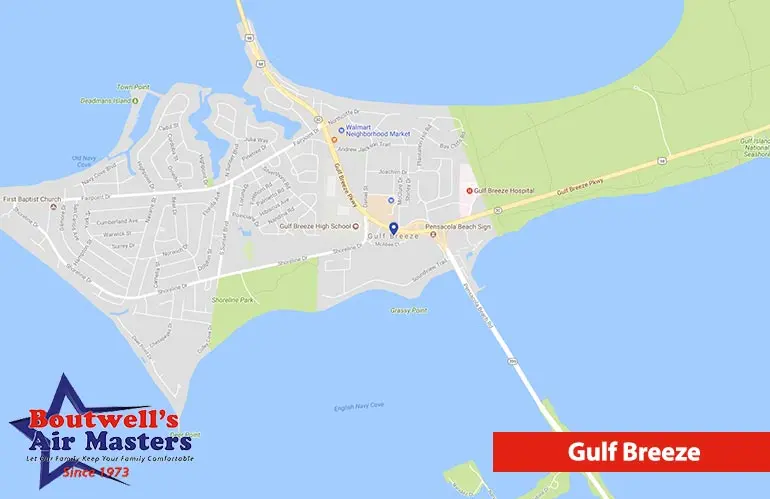
Gulf Breeze sits on a narrow peninsula between Pensacola Bay and Santa Rosa Sound, which means water is never far from any town home. That location keeps summer days warm and humid and lets nighttime temperatures drop more than people expect, especially in winter. It's why every home here needs both a dependable air conditioner and a working heating system, not just one for half the year.
We've worked in enough homes on this peninsula to know exactly how being surrounded by water affects HVAC equipment compared to homes just a few miles inland. Alongside Gulf Breeze, we serve Navarre, Midway, Pace, Milton, and the wider Pensacola area.
Dealing with uneven airflow or a system that's struggling to circulate air properly? Learn more about our Air Handler Services.
Heating Repair in Gulf Breeze: Is Your Heater Blowing Cold Air?
Even on a peninsula, Gulf Breeze nights get cold in winter, and it catches a lot of people off guard given how mild the days usually are. The cold season here is short, so a lot of homeowners don't think about their furnace until they actually need it, sometimes not until the first real cold snap of the year. Two or three winters can pass without a single check, especially in older Tiger Point and Villa Venyce homes, where the heating system has been running the same way since the houses were built.
A struggling heater rarely fails without warning. It shows small signs at first, and catching them early usually means a simple repair rather than a full replacement later on. Watch for:
- Vents blowing cold air instead of warm
- One room cold while another warms up fine
- The system switching on and off more than usual
- Banging, clicking, or other odd noises on startup
- A heating bill climbing with no change in usage
- A burning or dusty smell that lingers past the first run of the season
One of these alone isn't necessarily a big deal. Several together are worth a look before the next cold snap hits, rather than waiting to see if the system sorts itself out. A heater struggling now won't fix itself, and it tends to get worse the longer it's left alone. A repair today, while it's still a minor fix, beats an emergency call in the middle of a cold night when the temperature has already dropped, and everyone in the house is uncomfortable. We handle heating repair and replacement throughout Gulf Breeze, from quick fixes to full system installs, so your home stays warm no matter how far the temperature drops outside.
AC Repair in Gulf Breeze: Why Your System Can't Keep Up With the Humidity
If you've spent a summer in Gulf Breeze, you already know the heat isn't the real problem, it's the air itself. A broken AC on a day like that is more than an inconvenience with two large bodies of water sitting this close to town. And when a unit starts struggling, it doesn't just leave the house hot. It leaves it feeling heavier and stickier than the thermometer would suggest, because all that moisture has nowhere to go.
That's actually the pattern behind most of the calls we get here. It's rarely a system that's fully broken down. More often, it's one that's running nonstop and still can't get the house comfortable. When we see that in Gulf Breeze, it usually comes down to one of a few things:
- A refrigerant leak, which cuts cooling capacity even if the unit's still turning on
- A dirty or failing coil, which limits how much heat the system can actually pull out of the air
- Ductwork that's losing cooled air before it ever reaches the rooms that need it
- A system that's undersized or just getting older, still cooling fine but no longer keeping up with the dehumidifying
Rather than guess which one it is, our technicians check for all four before recommending anything. That way you're not paying for a coil cleaning when the real issue was a refrigerant leak the whole time, or replacing a unit that just needed a duct repair. And since we keep the parts most local systems need right on the truck, most repairs get finished the same day, so you're not left running a struggling AC for another week while a part ships in from somewhere else.
Looking for a flexible cooling option for a room addition, garage, or a home without existing ductwork? Check out our Ductless Mini Split AC Systems.
Repair or Replace? What Makes Sense for a Coastal AC Unit
Once we've diagnosed the problem, the next question is usually whether it's worth fixing or time to replace the unit, and that answer looks a little different for a home this close to the water. As a general rule, repair makes sense when the system is under 10 years old and the issue comes down to a single failed component. Replacement tends to be the better value once a coastal unit hits 10 to 12 years old, the coils have corroded, it's still running on the discontinued R-22 refrigerant, or the repair itself would cost more than a third of a new system.
That timeline moves faster in Gulf Breeze than it does further inland. Salt air wears down equipment here in a way that just doesn't happen a few miles from the water, so a unit that would still have plenty of life left elsewhere in Santa Rosa County might already be nearing the end of the road on the peninsula.
When it is time for something new, getting the size right matters more here than almost anywhere else in the county. An oversized unit cools the house quickly but shuts off before it's pulled enough moisture from the air, which leaves things feeling cool and clammy at the same time. An undersized one just runs nonstop and burns out early trying to keep up. We size every installation around the actual home rather than a rule of thumb, recommend coastal-grade equipment for anything near the Sound or the Bay, and hand you a written quote spelling out the equipment, efficiency rating, and warranty before anything gets ordered. Financing is available if you'd rather spread out the cost.
Looking for a flexible cooling option for a room addition, garage, or a home without existing ductwork? Check out our Ductless Mini Split AC Systems.
Coastal HVAC Problems in Gulf Breeze: Why Salt Air Corrodes AC Units Faster
Because Gulf Breeze is bordered by water on more than one side, homes here get more direct salt exposure than homes farther north in Santa Rosa County. Outdoor condenser units near Santa Rosa Sound or Pensacola Bay corrode faster without regular rinsing and coil cleaning, and the metal fins on an unprotected unit can start showing real wear within a couple of years. Once those fins degrade, the unit loses its ability to shed heat, so the whole system works harder for less cooling, and the compressor pays the price.
The humidity coming off both bodies of water adds a second layer to the problem. Your AC isn't only cooling the air — it's constantly pulling moisture out of it too. When a system is undersized or aging, or when ductwork develops leaks, moisture control breaks down, resulting in a home that feels cool yet damp, which can eventually lead to musty odors or mold growth in the ducts themselves. A few things make a measurable difference on the peninsula:
- Rinse the outdoor unit with fresh water regularly to keep salt from settling on the coil.
- Schedule professional coil cleaning twice a year rather than once
- Ask about coastal-grade coil coatings on any new installation
- Keep up with routine maintenance, since salt and humidity accelerate wear here more than they do inland
None of this stops salt air from doing what salt air does, but it slows it down considerably — and over a decade that's often the difference between one system and two. When we service a home near the water, we look at the condenser cabinet and coil condition as closely as the refrigerant and electrical side, because that's where coastal systems fail first. If your unit has never been evaluated specifically for salt exposure, it's worth having it evaluated before the next cooling season.
Indoor Air Quality & Duct Cleaning in Gulf Breeze: Why Your AC Smells Musty
The air quality inside your Gulf Breeze home deserves as much attention as what's happening outside. Dust, pollen, mold spores, and VOCs all affect indoor air quality and pose a real risk for anyone with asthma, allergies, or other respiratory conditions. That risk climbs in a humid peninsula climate, where moisture supports mold and allergen growth far more easily than it would inland.
A musty smell coming from your vents usually means moisture has built up somewhere in the ductwork or on a coil that needs cleaning — especially if the smell shows up right after the AC kicks on. Left alone, that trapped moisture doesn't just smell bad; it gives mold and mildew a place to grow inside a system you can't see into. Signs worth acting on include:
- A musty or sour odor that appears when the system starts up
- Visible dust or debris around supply vents
- Allergy symptoms that get worse indoors rather than better
- Standing water or slime in the condensate drain pan
Our duct cleaning and air sanitization services clear out what's already built up and reduce what keeps circulating, so the air moving through your vents is something you don't have to think twice about.
Why Is Your Energy Bill So High? Gulf Breeze HVAC Efficiency Explained
A rising utility bill is one of the clearest signs your HVAC system isn't running as efficiently as it should, and it's easy to overlook until the bill actually arrives. In a humid coastal town, your system already works harder than it would inland just to keep up with the moisture in the air, so any additional strain shows up fast in your monthly cost.
The frustrating part is that the cause is rarely the thing homeowners suspect. More often than not, it isn't the AC itself but everything around it — the ductwork, the filter, or the house envelope. Common culprits include:
- Gaps or cracks in your home's walls or windows that let conditioned air escape
- An aging system losing efficiency as it nears the end of its lifespan
- Ductwork leaks that force your system to run longer than it should
- A clogged filter or dirty coil making the system work harder for the same result
We install eco-friendly equipment and test your home's shell for the holes and cracks that let conditioned air out. Sealing those gaps means your system works less to keep the house comfortable, and in a coastal home, it also reduces how much salt-laden, humid air gets pulled inside in the first place — which protects the equipment while lowering the bill.
Gulf Breeze HVAC Maintenance Checklist: Seasonal AC and Heating Care
Gulf Breeze homes face heavy summer humidity and year-round salt exposure, so a seasonal check of your system can catch problems a once-a-year glance would miss. None of this replaces a professional inspection, but these habits catch much of the day-to-day wear that comes with living this close to the water.
Heading into summer, focus on the outdoor unit and airflow:
- Rinse the outdoor unit with a garden hose every few weeks to clear off salt buildup, especially within a mile or two of the Sound or the Bay.
- Change or clean your air filter monthly during peak cooling months, since a clogged filter makes both cooling and dehumidifying harder.
- Keep at least two feet of clearance around the outdoor unit, free of shrubs, furniture, or debris that traps moisture against the cabinet.
- Check that condensate lines are draining freely rather than backing u.p
Heading into winter, shift attention to the heating side:
- Run the heat for a few minutes before the first cold night so any problem surfaces on your schedule, not at 2 a.m.
- Listen for changes in sound or a drop in airflow — both are early signs worth a professional look.
- Replace filters again as we head into the heating season.
- Book a professional tune-up twice a year, once before summer and once before winter, rather than the single annual visit that works inland.
Our maintenance plan covers both seasonal tune-ups, includes a coastal coil cleaning, and gives members priority scheduling when the weather turns and everyone calls at once.
Our AC and Heating Repair Process in Gulf Breeze, FL
A broken AC or heater is stressful enough without having to wonder how long you'll be waiting or what it'll cost. We've streamlined our process over more than 50 years on the Gulf Coast so homeowners always know exactly what to expect, from the moment you pick up the phone to the moment your system is running again.
- You call or schedule online: Tell us what's going on and we'll get you on the schedule, with no-cool and no-heat emergencies moved to the front of the line.
- A technician diagnoses the problem: We pinpoint the issue and walk you through our findings before any quote is issued.
- You get upfront pricing before any work starts: No surprise charges once the job is underway.
- We complete the repair, often in the same visit: Our trucks carry the parts most Gulf Breeze systems need, so you're not waiting days for a part to ship.
If your system has stopped entirely, call us and tell us it's an emergency. No-cool and no-heat calls jump the queue, and because we already run routes through Gulf Breeze daily, we're rarely far away. You'll still get upfront pricing before any work starts — urgency never changes how we quote a job.
That's the whole process: no hidden steps, no pressure to add on services you didn't ask for. Boutwell's Air Masters is licensed and insured in the State of Florida, and has served the Gulf Coast since 1973.
Frequently Asked Questions
How fast can Boutwell's get to my Gulf Breeze home?
We run technicians through Gulf Breeze daily as part of our regular Santa Rosa County routes, so most calls get same-day or next-day service. No-cool and no-heat emergencies move to the front of the schedule, since we know how quickly a broken system turns into a real problem in this humidity.
How often should I service my AC in Gulf Breeze?
Twice a year, once before summer and once before winter. Coastal salt air and humidity wear equipment faster than inland conditions, so the standard single annual tune-up usually isn't enough here. The extra visit catches corrosion and moisture-related wear while it's still minor, before it turns into a costlier repair.
How long does an AC unit last in a coastal climate?
Expect roughly 10 to 12 years near the water, compared with 15 or more inland, unless the unit has coastal-grade coil protection and gets regular rinsing and professional cleaning. Salt exposure is the main reason for the shorter lifespan, as it accelerates corrosion on the outdoor unit's coils and cabinet beyond what routine wear alone would.
Do you offer coastal-grade protection for new units?
Yes. We can spec corrosion-resistant coil coatings and coastal-rated equipment on new installations, which makes a real difference for homes near the Sound or the Bay. It's a small upfront addition that meaningfully extends how long your system holds up against salt exposure, so it's worth bringing up whenever you're planning a new install.
What areas do you serve besides Gulf Breeze?
Gulf Breeze, Navarre, Midway, Pace, Milton, and the wider Pensacola and Santa Rosa County area. Our technicians run regular routes through all of these communities, which helps us keep response times short no matter where in the service area you're calling from.